Q2 2026 Market Review

The second quarter of 2026 marked a turning point for financial markets as investor focus gradually shifted away from geopolitical uncertainty and back towards economic fundamentals, corporate earnings and long-term investment themes. The announcement of a ceasefire framework between the United States and Iran helped reduce concerns over prolonged supply disruptions, leading to lower oil prices, improved market sentiment and a broad recovery across global asset classes.
Despite ongoing uncertainty around inflation and monetary policy, risk assets performed strongly during the quarter. Equity markets were supported by resilient corporate earnings and continued investment in artificial intelligence (AI), while fixed income markets benefited from improving credit conditions and a more stable outlook for interest rates.
Key market movements during the quarter included:
Developed market equities gained 13.9%, supported by strong corporate earnings and continued enthusiasm for AI-related investments.
Emerging market equities outperformed, returning 24.0%, driven by robust demand for semiconductors and technology exports from Taiwan and South Korea.
The Bloomberg Global Aggregate Bond Index delivered a positive return of 0.9%, as tighter credit spreads offset the impact of elevated government bond yields.
The Bloomberg Commodity Index declined 8.5%, reflecting lower energy prices and a correction in precious metals as geopolitical risks eased.
Artificial intelligence remained one of the most significant investment themes during the quarter. However, market attention increasingly shifted beyond AI applications towards the broader infrastructure required to support adoption, including semiconductors, cloud computing, data centres and advanced technology infrastructure. Continued investment from major technology companies reinforced expectations that AI represents a long-term growth opportunity, while also highlighting the importance of earnings delivery and valuation discipline.
Equity markets were further supported by improving investor confidence and resilient economic activity. Emerging markets benefited from their strategic position within the global technology supply chain, particularly Taiwan and South Korea, where semiconductor demand remained strong. Developed markets also performed well, although investors became increasingly selective as valuations in certain areas of the market remained elevated.
Fixed income markets provided additional portfolio resilience during the quarter. Although inflation remained above central bank targets in many developed economies, declining energy prices helped moderate inflation expectations and reduced concerns over further monetary tightening. At the same time, improving corporate fundamentals and tighter credit spreads supported returns across credit markets.
Looking ahead, the investment environment remains shaped by three key themes:
Inflation and monetary policy: Central banks remain focused on achieving price stability while balancing the risk of slowing economic growth.
Artificial intelligence and productivity: Continued investment in technology infrastructure could provide long-term opportunities across sectors and regions.
Market diversification: With valuations becoming increasingly important, maintaining exposure across different asset classes and regions remains essential.
While geopolitical developments and policy uncertainty are likely to continue influencing markets, the combination of resilient corporate earnings, improving economic conditions and long-term structural trends provides a constructive backdrop for investors. A disciplined and diversified approach remains important in navigating opportunities while managing potential periods of volatility. While market volatility is likely to persist, resilient corporate earnings, improving economic conditions and structural investment themes continue to support a constructive long term outlook for investors.
Inflation and Monetary Policy Remain Key Drivers
Inflation and monetary policy remained key drivers of market performance during the second quarter of 2026, with investors closely monitoring the impact of energy prices, economic growth and central bank policy decisions.
The quarter began with renewed inflation concerns following the increase in oil prices caused by geopolitical tensions. However, the subsequent easing of tensions and decline in energy prices helped moderate inflation expectations and supported a more constructive environment for financial markets.
Central banks continued to adopt a cautious approach, balancing the need to maintain price stability against signs of moderating economic activity.
Main policy developments during the quarter included:
The Federal Reserve maintained interest rates within the 3.50%–3.75% range, signalling that future decisions would remain dependent on inflation and economic data.
The Bank of Japan continued its policy normalisation process, increasing its policy rate to 1.0% as wage growth and domestic inflation pressures strengthened.
Other major central banks maintained a cautious stance as inflation remained above target levels in several economies.
The overall market environment reflected a shift away from expectations of further aggressive tightening towards a period of more stable monetary policy. While inflation remains a key risk, the moderation in energy prices provided some relief and reduced concerns around renewed inflationary pressures.
For investors, the path of monetary policy remains an important driver of asset class performance. A gradual normalisation of interest rates, combined with improving economic conditions, could provide support for both equity and credit markets, although uncertainty remains around the timing and pace of future policy changes.
Equities
Global equities rebounded strongly during the second quarter of 2026, supported by improving investor sentiment, resilient corporate earnings and continued investment in artificial intelligence (AI).
Market performance remained closely linked to the AI investment cycle, with technology and semiconductor companies continuing to benefit from strong demand across the broader AI ecosystem.
Key equity market movements during the quarter included:
Developed market equities gained 13.9%.
Emerging market equities outperformed, returning 24.0%.
Growth stocks continued to outperform value stocks, although market leadership began to broaden during the quarter.
AI remained a significant investment theme; however, investor focus increasingly shifted from AI applications towards the infrastructure required to support adoption, including semiconductors, data centres and cloud computing.
Emerging markets benefited significantly from their position within global technology supply chains, with Taiwan and South Korea among the strongest performers due to their exposure to semiconductor manufacturing and advanced technology exports.
US equities also performed strongly, supported by resilient earnings and continued technology investment. However, by the end of the quarter, investors became increasingly selective as valuations across some AI-related companies reached elevated levels.
The shift towards broader market participation highlighted the importance of maintaining diversified equity exposure rather than relying solely on individual themes. While AI continues to offer significant long-term opportunities, earnings delivery and valuation discipline remain important considerations.
Fixed Income
Fixed income markets delivered positive returns during the second quarter of 2026 despite a challenging interest rate environment. The Bloomberg Global Aggregate Bond Index gained approximately 0.9% during the quarter as improving investor confidence and tighter credit spreads offset the impact of elevated government bond yields.
Government bond markets remained influenced by persistent inflation concerns and expectations around the future path of monetary policy. While central banks maintained a cautious approach, investors increasingly shifted away from expectations of further aggressive tightening towards a more stable interest rate environment.
A key theme during the quarter was the resilience of credit markets. Corporate bonds benefited from:
Improving economic conditions and reduced recession concerns.
Stronger corporate balance sheets following years of disciplined financial management.
Lower geopolitical uncertainty, which supported investor risk appetite.
Tighter credit spreads, which contributed positively to overall returns.
As a result, corporate bonds generally outperformed government bonds during the quarter, providing investors with additional income and diversification benefits.
The current environment remains supportive for high-quality fixed income assets. Although yields remain above the levels experienced over the previous decade, providing investors with more attractive income opportunities, selectivity remains important given differences in credit quality and regional economic conditions.
Commodities
Commodity markets declined during the second quarter of 2026, with the Bloomberg Commodity Index falling approximately 8.5% as easing geopolitical tensions reduced supply concerns and supported a broader decline in inflation expectations.
Oil was one of the weakest-performing segments during the quarter. Following the initial surge in prices earlier in the year due to concerns around Middle East supply disruptions, oil prices retraced significantly as the probability of prolonged disruptions diminished.
Key factors driving the decline included:
Lower geopolitical risk premiums following progress towards a ceasefire framework.
Reduced concerns over supply disruptions in major energy markets.
Improved expectations around global energy availability.
As a result, oil prices moved towards approximately USD 70 per barrel, falling below the levels reached during the earlier period of heightened geopolitical uncertainty. The decline in energy prices provided some relief to consumers and businesses while reinforcing expectations that inflationary pressures could continue to moderate.
Precious metals also experienced a correction during the quarter as investor demand for defensive assets declined. Gold fell from approximately USD 4,539 per ounce towards the USD 4,000 level, as improving market sentiment and higher expected yields reduced demand for traditional safe-haven assets.
However, the longer-term outlook for commodities remains supported by several structural trends. Demand related to electrification, infrastructure investment and artificial intelligence continues to support selected industrial commodities, while geopolitical uncertainty and central bank demand remain potential sources of support for precious metals.
Overall, the decline in commodity prices during Q2 2026 represented a normalisation following earlier risk-driven gains and contributed positively to the broader disinflation narrative.
Currency
The US dollar experienced a period of volatility during the second quarter of 2026, initially continuing its weakness from earlier in the year before recovering as expectations around monetary policy shifted.
The earlier weakness reflected reduced investor demand for US assets, concerns around fiscal sustainability and expectations that the Federal Reserve could begin easing monetary policy. However, sentiment improved during Q2 as markets reassessed the pace of potential rate cuts and US economic resilience remained evident.
The recovery in the dollar was supported by several factors:
More favourable yield differentials as expectations for aggressive monetary easing were reduced.
Resilient US economic data, which supported confidence in the relative strength of the US economy.
Renewed demand for US assets as investors reassessed global growth and policy risks.
The dollar’s recovery reflected a broader shift in market expectations, with investors placing greater emphasis on differences in economic performance and central bank policy paths across regions. While earlier concerns weighed on the currency, the relative attractiveness of US yields and continued economic resilience provided support.
Summary
Overall, the second quarter of 2026 was characterised by improving investor confidence, easing geopolitical concerns and renewed focus on long-term growth themes.
Key developments during the quarter included:
A strong recovery in global equities, led by AI-related investment and resilient corporate earnings.
Positive fixed income returns as credit markets remained supportive.
Lower commodity prices, particularly oil, which helped improve inflation expectations.
A recovery in the US dollar as investors reassessed monetary policy expectations.
While risks remain, including geopolitical uncertainty and valuation pressures, the combination of resilient earnings, structural investment themes and improving macroeconomic conditions provides a constructive backdrop for long-term investors.
United Kingdom: Policy Transition and Economic Outlook
The United Kingdom entered the second quarter of 2026 amid a period of political transition and economic uncertainty, with policymakers focused on improving growth prospects while addressing persistent inflationary pressures.
The government’s policy agenda has centered around structural reforms, public spending priorities and potential changes to the tax framework. Discussions around increasing investment in strategic sectors, improving infrastructure and reforming public services reflect a broader ambition to strengthen long-term economic growth. However, the scale and implementation of these measures remain important considerations for investors, particularly given the UK’s existing fiscal constraints.
A key area of debate has been the potential shift towards greater taxation of wealth and assets, alongside possible changes to capital gains taxation and other revenue-raising measures. While such reforms could support public finances over the longer term, uncertainty around their design and implementation may continue to influence business confidence and investment decisions in the near term.
Inflation remains a key challenge for the UK economy. Consumer price inflation remains above the Bank of England’s 2% target, with services inflation and previous energy-related cost pressures contributing to a slower path towards price stability. As a result, the Bank of England has maintained a cautious approach, balancing the need to control inflation against signs of moderating economic activity.
Key factors influencing the UK outlook include:
Inflation persistence: Services inflation and wage pressures remain areas of focus for policymakers.
Interest rate expectations: Markets anticipate rates will remain elevated for longer as the Bank of England assesses the sustainability of disinflation.
Growth challenges: High borrowing costs and weaker consumer confidence continue to weigh on domestic activity.
Structural reforms: Successful implementation of growth-oriented policies could improve the UK’s longer-term economic prospects.
From an investment perspective, UK equities continue to trade at relatively attractive valuations compared with global peers. However, the market remains constrained by weaker domestic growth expectations and a sector composition that is more heavily weighted towards traditional industries compared with technology-focused global markets.
Overall, the UK outlook remains a balance between near-term uncertainty and longer-term opportunity. While monetary policy and fiscal developments are likely to influence sentiment in the short term, improvements in economic stability and successful structural reforms could provide a more supportive backdrop over time.

Macroeconomic Outlook
The global economy enters the second half of 2026 with a more balanced outlook, supported by moderating inflation, resilient corporate activity and improving financial conditions. While growth remains below the levels seen in previous cycles, concerns around a sharp global slowdown have eased as consumer spending remains relatively stable and businesses continue to invest in long-term growth opportunities.
Economic performance, however, remains uneven across regions. The United States continues to demonstrate resilience, supported by strong corporate investment and ongoing spending in technology and artificial intelligence infrastructure. Europe faces a more challenging environment, with weaker domestic demand and slower industrial activity weighing on growth prospects. Emerging markets remain supported by structural growth drivers, improving export conditions and increasing investment in technology and infrastructure.
GDP growth:
Global growth is expected to remain positive but moderate as economies continue to adjust to higher interest rates. The resilience of corporate investment, particularly in areas such as artificial intelligence, digital infrastructure and energy transition, remains an important support for economic activity.
The main factors shaping the growth outlook include:
Resilient business investment: Continued spending on technology and infrastructure is supporting productivity and long-term growth potential.
Moderating consumer activity: Higher borrowing costs continue to weigh on households, although labour markets remain relatively supportive.
Regional divergence: The US and selected emerging markets are expected to outperform regions facing weaker domestic demand.
While recession risks have moderated, the outlook remains sensitive to geopolitical developments, inflation trends and the impact of restrictive monetary policy
Real GDP growth forecasts

Source: IMF
Annual real GDP growth rates from 1980 to 2030 for the major economies.

Inflation expectations
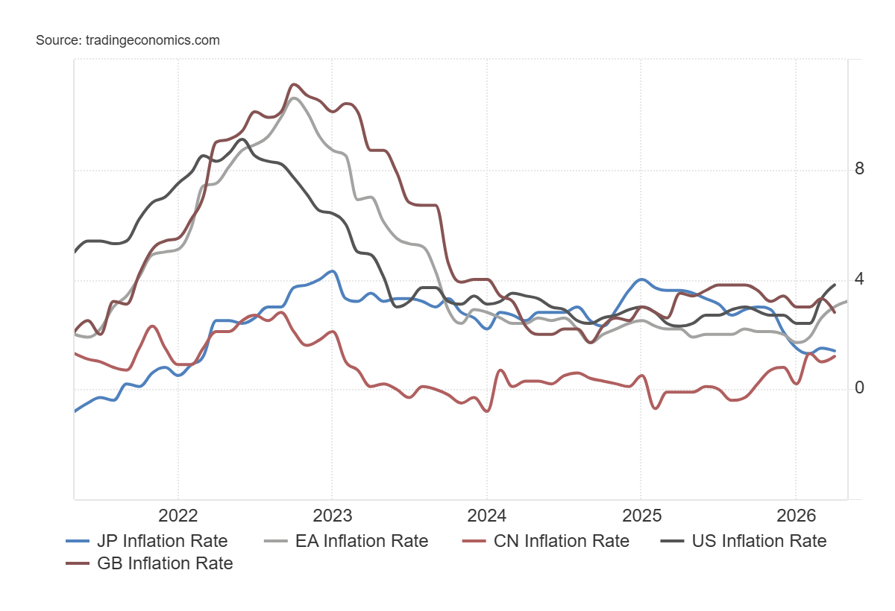
Inflation continues to moderate across major economies, although the pace of improvement has been slower and more uneven than initially expected. While the decline in energy prices during the quarter helped ease headline inflation pressures, renewed volatility in commodity markets and persistent services inflation continue to influence the outlook.
Inflation dynamics are expected to remain different across regions, reflecting variations in energy dependence, exchange rate movements, labour market conditions and domestic demand trends.
In the United States, inflation remains above the Federal Reserve’s 2% target, with services inflation and resilient economic activity contributing to a more gradual path towards price stability. As a result, expectations for rapid monetary easing have moderated, with the Federal Reserve expected to remain cautious in adjusting policy.
In Europe and the United Kingdom, inflation risks remain more sensitive to energy prices due to greater reliance on imported energy. While inflation has declined from previous peaks, persistent services inflation and wage pressures continue to support a more cautious outlook for the pace of disinflation.
In Japan, inflation dynamics remain closely linked to wage growth and currency movements. Although earlier food and commodity price pressures are expected to ease, the weaker yen continues to create upward pressure through higher import costs. Meanwhile, China continues to experience a more subdued inflation environment, reflecting weaker domestic demand and ongoing adjustments within the property sector.
Overall, inflation is expected to continue trending lower, but the final stage of returning towards central bank targets is likely to be gradual. This reinforces the likelihood that monetary policy will remain dependent on incoming economic data rather than following a predetermined path.
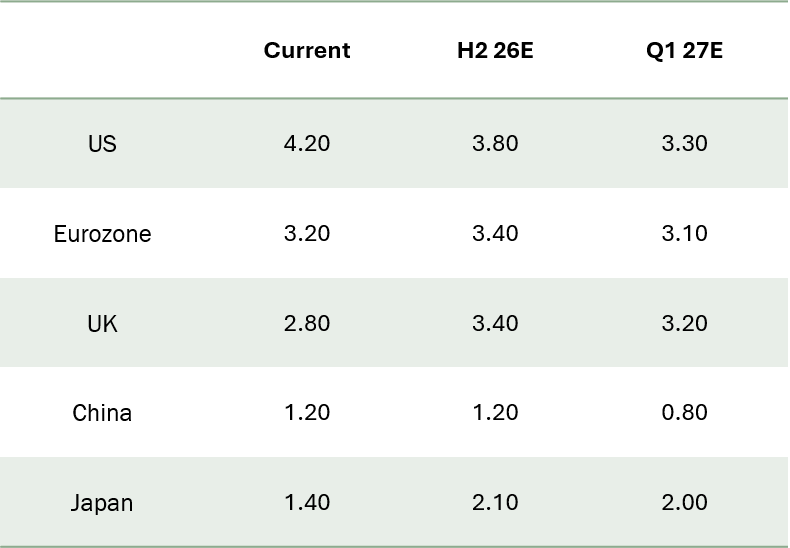
Source: Trading Economics
Core inflation trends across major economies (US, EA, UK, China, and Japan) from 2021 to 2025.
Interest rate expectations:
The global monetary policy environment has entered a more cautious phase as central banks continue to balance persistent inflation pressures against moderating economic growth. While the aggressive tightening cycle of 2022 and 2023 has largely passed, policymakers remain focused on ensuring that inflation continues to move sustainably towards target before committing to further easing.
In the United States, expectations for monetary easing have moderated as inflation has remained more persistent than initially anticipated. Earlier expectations of approximately 50 basis points of rate cuts have been pushed back as the Federal Reserve maintains a data-dependent approach, prioritising price stability while monitoring economic resilience.
The European Central Bank has also adopted a more cautious stance as inflation pressures, particularly from services and energy costs, remain a concern. While economic activity remains subdued, policymakers continue to balance the need to support growth against the risk of inflation proving more persistent than expected.
In contrast, Japan continues to move in the opposite direction, gradually normalising monetary policy after decades of ultra-low interest rates. Following the exit from negative interest rates, the Bank of Japan has moved its policy rate towards 1.0%, reflecting stronger wage growth and a more sustainable inflation environment. However, the weaker yen remains a key consideration as it contributes to higher import costs and inflation risks.
Meanwhile, China remains an exception among major economies, with monetary policy expected to remain supportive as policymakers focus on stimulating domestic demand and addressing challenges within the property sector. The lower inflation environment provides greater flexibility for authorities to maintain an accommodative policy stance.
From a broader perspective, the current interest rate environment represents a structural shift compared with the decade following the global financial crisis, when ultra-low rates and abundant liquidity dominated markets. Although policy rates have begun to decline from their peaks, they are expected to remain structurally higher than pre-2022 levels.
Interest Rate Expectation (%)

Source: Trading Economics
Interest rate trends for major economies (US, EA, UK, China, and Japan) from 2021 to 2026.

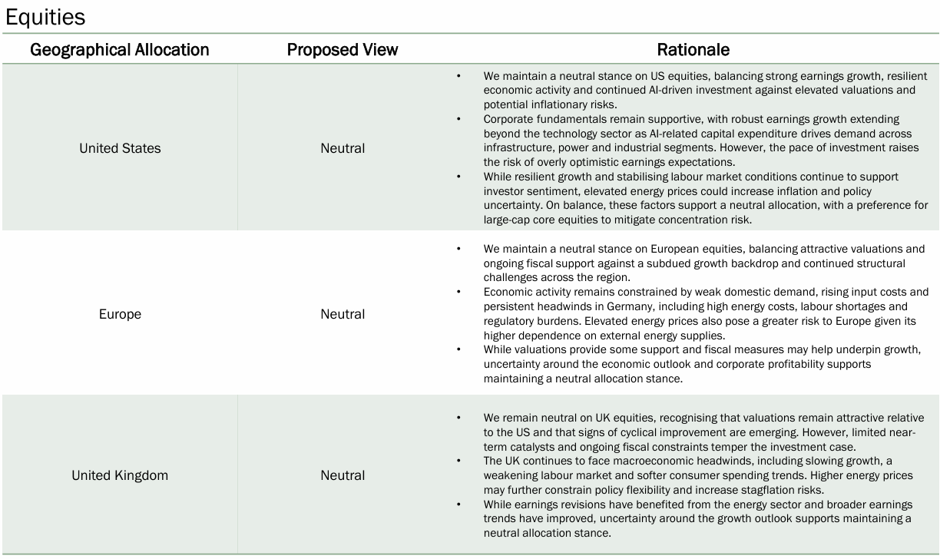
Asset class views



Comments